
With the rapid development of modern optical technology, precision applications such as microscopic observation, spectral analysis, and machine vision inspection are placing increasingly stringent demands on the spectral control accuracy of optical systems. In such systems, optical filters play the pivotal role of "spectral gatekeepers"—they selectively transmit specific portions of the spectrum while efficiently blocking other wavelengths, providing precise spectral control capabilities for optical systems. This article will systematically outline the core principles, key technical parameters, mainstream classifications, and application characteristics of optical filters, assisting professionals in making accurate selections.
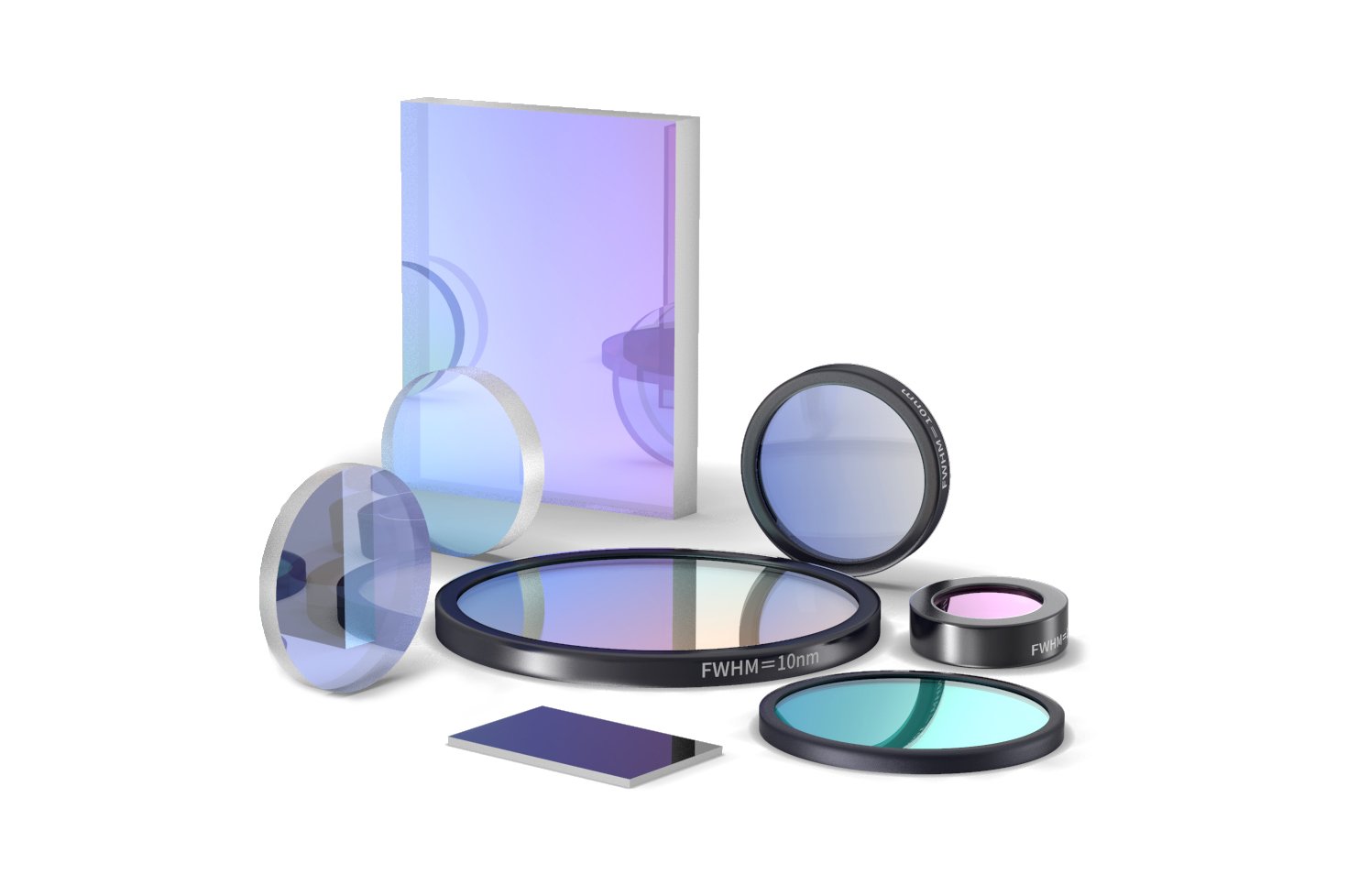
Core Principle: The Underlying Logic of Spectral Selection
The core function of an optical filter stems from its selective interaction with light, which is primarily achieved through two distinct mechanisms: firstly, utilizing the inherent absorption properties of materials to block specific wavelengths of light; secondly, based on the principle of thin-film interference, where precisely deposited coatings cause specific wavelengths to be transmitted due to constructive interference, while others are blocked due to destructive interference. The different manufacturing technologies derived from these two principles determine the performance differences and application scenario specializations of optical filters. Currently, interference filters have become mainstream due to their flexible design and superior performance, while absorption filters, leveraging their cost advantage, remain widely used in basic applications.
Key Technical Parameters: Core Metrics of Filter Performance
Accurately understanding filter parameters is a prerequisite for selection. Below is an authoritative interpretation of the industry-standard core metrics:
Center Wavelength (CWL)
As the core defining parameter of a filter, it refers to:For Longpass Filters: The wavelength at which transmittance rises to 50% (as shown in Figure 2 below).
For Shortpass Filters: The wavelength at which transmittance falls to 50% (as shown in Figure 3 below).
For Bandpass Filters: The spectral midpoint of the transmission band (as shown in Figure 4 below).
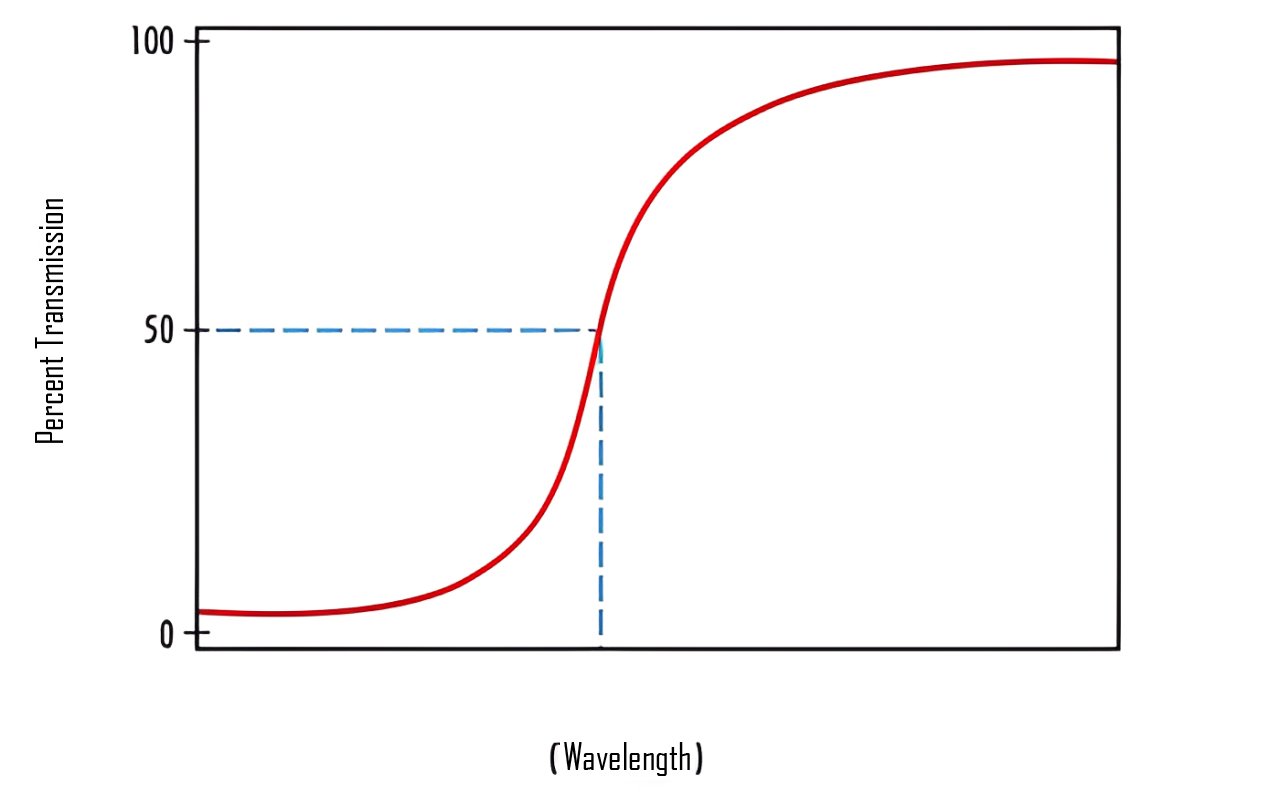
Figure 2: Schematic Diagram of the Center Wavelength for a Longpass Filter
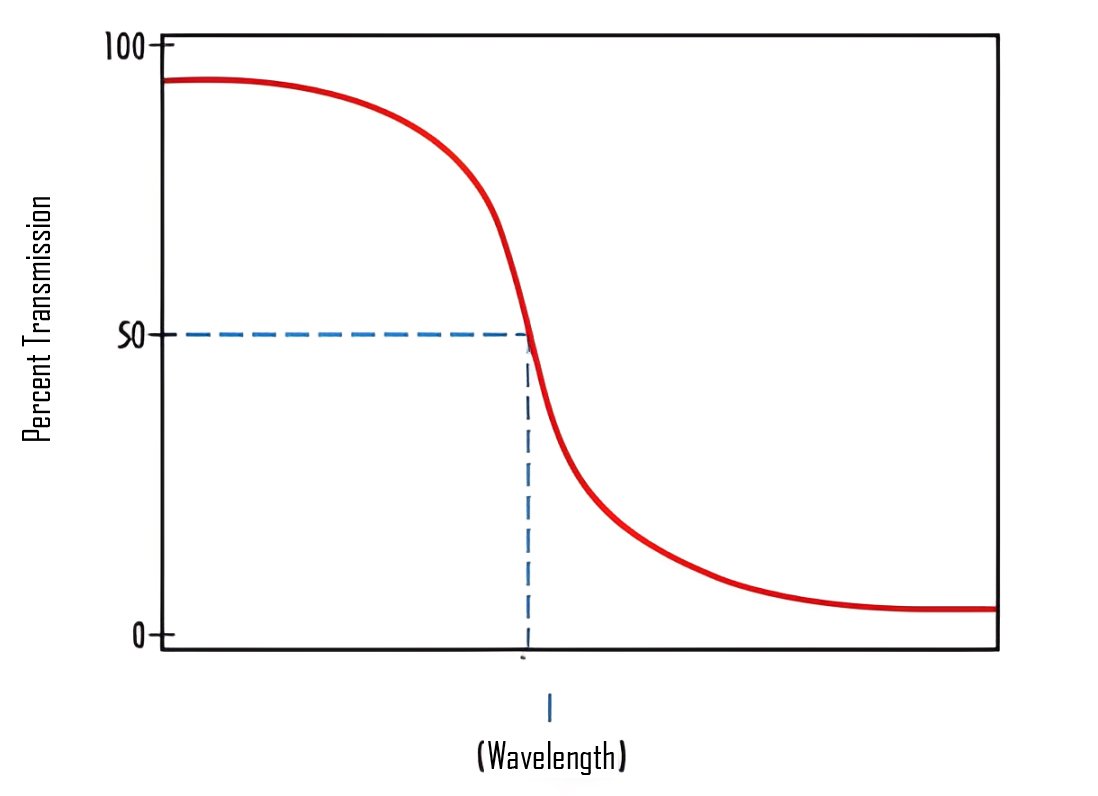
Figure 3: Schematic Diagram of the Center Wavelength for a Shortpass Filter
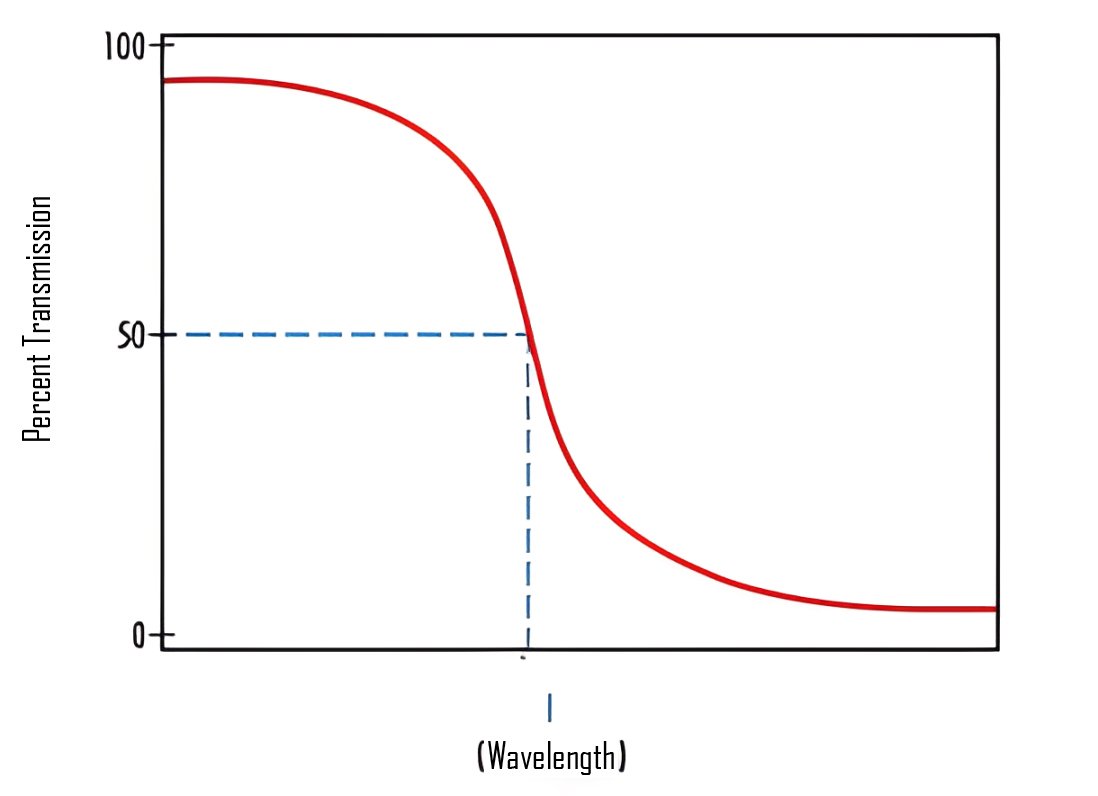
Figure 4: Schematic Diagram of Center Wavelength (CWL) and Full Width at Half Maximum (FWHM) for a Bandpass Filter
2. Bandwidth and Full Width at Half Maximum (FWHM)
Bandwidth refers to the range of wavelengths allowed to pass through the filter. It is commonly quantified in the industry using the Full Width at Half Maximum (FWHM)—defined as the wavelength interval between the two points where the filter's transmittance drops to 50% of its peak value (as shown in Figure 4). Based on bandwidth range, filters can be categorized into:
Narrowband Filters (FWHM ≤ 10nm): Suitable for laser purification, chemical detection.
Medium-band Filters (FWHM 25-50nm): Widely used in mainstream machine vision applications.
Broadband Filters (FWHM > 50nm): Used in scenarios like fluorescence microscopy.
For example, for a filter with a peak transmittance of 90%, its FWHM is defined by the two wavelengths corresponding to a transmittance of 45%.
3. Blocking Range
This refers to the wavelength range outside the passband that is required to be blocked (attenuated). The degree of blocking is typically specified using Optical Density.
4. Optical Density (OD)
This parameter characterizes the light-blocking capability of a filter. The value has a negative logarithmic relationship with transmittance: a higher OD corresponds to lower transmittance, and vice versa. The conversion formula is:
Transmittance
T = 10^(-OD) × 100%Optical Density
OD = -log₁₀(T / 100%)
Different application scenarios have significantly varying OD requirements:Raman Spectroscopy & Fluorescence Microscopy: Require extreme blocking capabilities with OD ≥ 6.0.
Laser Separation/Purification & Machine Vision: Typically use filters with OD 3.0–4.0.
Basic applications like Color Sorting: OD ≤ 2.0 is generally sufficient.
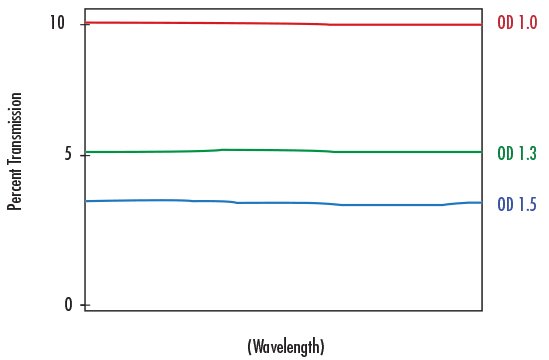
Figure 5: Schematic Diagram of the Relationship between Optical Density and Transmittance in a Neutral Density Filter
5. Slope
Slope is a critical parameter for edge filters (longpass and shortpass filters). It describes the width of the transition band from high blocking to high transmission and is usually expressed as a percentage of the cutoff wavelength. It is typically defined as the wavelength interval between the points of 10% transmittance and 80% transmittance. For example, a 500nm longpass filter with a slope of 1% achieves the transition from 10% to 80% transmittance over a spectral width of 5nm.
6. Dichroic Characteristic
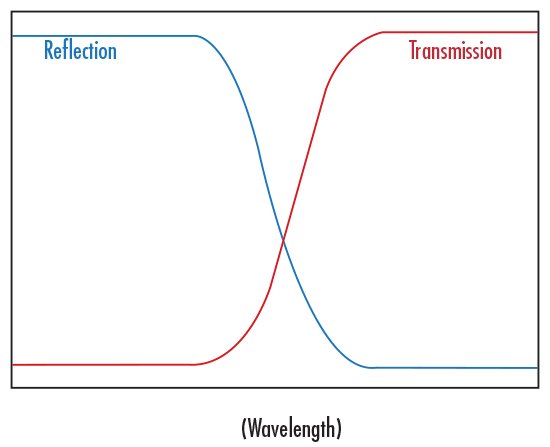
Dichroic filters (or beamsplitters) can selectively transmit or reflect light based on wavelength — transmitting a specific wavelength range while reflecting other wavelengths, as illustrated in Figure 5 above.
Clarify the spectral requirements of the application. For example, fluorescence microscopy typically requires broadband bandpass filters with high OD blocking capabilities, or specialized fluorescence microscope filter sets.
Consider environmental parameters, such as the impact of the angle of incidence on interference filters.
Balance performance and cost. Absorption filters are often prioritized for basic applications, while interference filters are chosen for high-end, precision scenarios.
Advantages: High design flexibility and superior performance.
Disadvantages: Higher cost, sensitive to the angle of incident light.
Applications: The mainstream choice for high-end, precision applications.
Advantages: Low cost, insensitive to the angle of incident light.
Disadvantages: Insufficient spectral edge steepness, prone to fluorescence or thermal effects.
Applications: Suitable for basic scenarios where high precision is not critical.
Absorption Filters: Utilize the absorption properties of materials like colored glass to achieve filtering.
Interference Filters (or Thin-Film Filters): Achieve filtering through the interference principle by depositing alternating layers of dielectric films with different refractive indices onto a substrate.
Longpass Filters (LP): Transmit longer wavelengths while blocking shorter wavelengths. Key parameters: Center Wavelength, Slope, Transmission Band, Blocking Range, and Blocking Depth (OD).
Shortpass Filters (SP): Transmit shorter wavelengths while blocking longer wavelengths. Key parameters: Center Wavelength, Slope, Transmission Band, Blocking Range, and Blocking Depth (OD).
Bandpass Filters (BP): Transmit only a specific wavelength range. Key parameters: Center Wavelength and Full Width at Half Maximum (FWHM).
Neutral Density Filters (Attenuators): Used to attenuate the optical power of a light source uniformly across a broad spectrum. Key parameter: Optical Density (OD) over the specified wavelength range.


